FAA Decision on Cloud-Seeding Drones by Rainmaker Technology Could Shape Future Weather Modification Regulations
Cloud-seeding technology company Rainmaker Technology’s application to deploy cloud-seeding flares on small drones is facing opposition from the Airline Pilots Union, who have urged the Federal Aviation Administration (FAA) to reconsider the request unless stricter safety guidelines are met.
The FAA’s decision will be indicative of how it views weather modification by unmanned aerial systems in the future. Rainmaker Technology’s reliance on small drones is at stake.
In a statement to the FAA, the Air Line Pilots Association (ALPA) argued that Rainmaker’s petition falls short in demonstrating an equivalent level of safety and poses an extreme risk to safety.
However, Rainmaker CEO Augustus Doricko asserted that all of the union’s objections are based on the public notice rather than confidential documents submitted to the FAA, which detail the company’s safety data and risk mitigations.
Rainmaker is seeking an exemption from rules that prohibit small drones from carrying hazardous materials. The application was filed in July, and a decision is yet to be made by the FAA. Instead, it has requested additional information, focusing on operations and safety details.
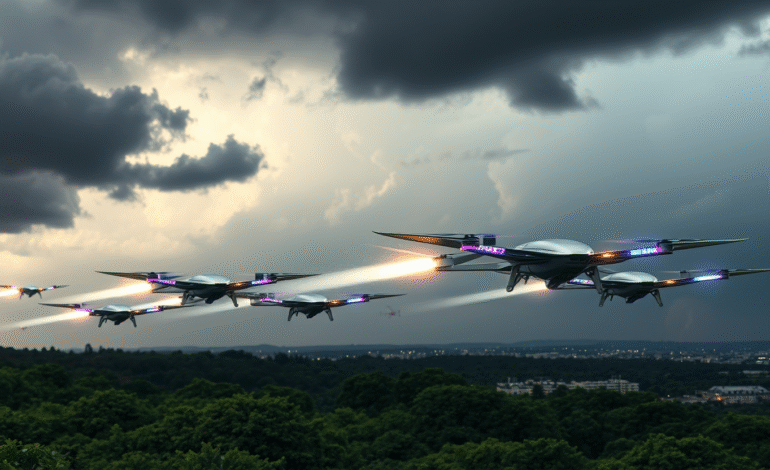
In its filing, Rainmaker proposed using two types of flares – ‘burn-in-place’ and ejectable – on its Elijah quadcopter, to disperse particles that stimulate precipitation. The Elijah drone can reach an altitude of 15,000 feet above mean sea level (MSL), which falls within controlled airspace where commercial airliners frequently fly. Drones require Air Traffic Control permission to operate in this area.
Rainmaker’s application states that it will operate in Class G (uncontrolled) airspace unless authorized otherwise. ALPA notes the application does not provide clear details about flight locations or altitudes, but Doricko confirmed that the documents submitted to the FAA specify flights will be limited to a maximum altitude of 15,000 feet MSL and will take place in predetermined safe airspace as verified by aviation authorities, thus alleviating concerns regarding high-altitude flight or airspace coordination.
The union also objects to the flares themselves, raising concerns about foreign object debris and fire safety. ALPA points out that the petition does not include trajectory modeling of ejectable casings or analysis on the environmental impacts of chemical agents.
Regarding the union’s objections to the use of flares, Doricko stated that independent bodies such as the Environmental Protection Agency (EPA) and multiple state departments of natural resources have studied the dispersion and environmental safety of materials used in cloud seeding for over 70 years without finding any adverse effects from cloud seeding.
Sam Kim, Rainmaker’s aviation regulatory manager, said the company values the union’s input and aims to strengthen its relationship with the organization but claimed that the objection reflects a limited understanding of why Rainmaker has filed for this exemption.
“Our use of flares in unmanned systems is solely for research purposes in a controlled flying environment and is not part of our ongoing operations,” Kim added.
Doricko explained that a typical Rainmaker operation disperses 50-100 grams of silver iodide, while significantly less is used in flights with flares. In contrast, commercial planes release kilograms of uncombusted volatile organics, sulfur oxides, and soot during an hour of flight – much more material than a Rainmaker operation.
“Rainmaker is committed to responsible atmospheric research and compares the use of flares with our proprietary aerosol dispersion system that will replace flares and solely emit silver iodide,” Doricko said.
ALPA’s concerns about coordination with aviation authorities and airspace were addressed by Doricko, who stated that flight operations involve broadcasting signals, intentional coordination with local Air Traffic Control (ATC), certified pilots, and a collision avoidance system that incorporates both electronic and physical observers.
Rainmaker confirmed that the flights will occur over rural areas and properties owned by private landlords with whom they have developed close working relationships.
Cloud-seeding is already practiced extensively today, primarily in the western United States, using crewed airplanes coordinated with state agencies. Ski resorts commission these operations to help maintain snowy slopes, and irrigation and water districts use them to build winter snowpack that helps supply reservoirs during the spring melt.
The concept of cloud seeding dates back to the 1950s when scientists found that spraying small particles into certain clouds could induce precipitation. Typically, cloud-seeding operations utilize silver iodide for the particles due to their similarity in shape with ice crystals.
When a silver iodide particle collides with supercooled water droplets, it causes the droplet to freeze rapidly because its temperature is already below freezing point. Once an ice crystal forms, it can grow quickly if conditions are favorable, growing faster than a liquid water droplet would in similar circumstances. Additionally, the rapid growth helps the crystals remain stable longer than water droplets, which may evaporate before they have a chance to fall as precipitation.
Rainmaker’s innovation – performing this work using drones instead of pilots – could potentially improve safety in the long term. The company emphasizes that flight profiles are tightly controlled, monitored by remote pilots and trained crews, over rural areas, with additional safety measures in place.
The FAA’s response will determine whether the safety mitigations provided by Rainmaker are deemed sufficient, setting a precedent for future novel cloud-seeding approaches.