Meta Smart Glasses Demo Fails at Conference Due to Resource Management Mistake and Unexpected Bug
Meta’s Chief Technology Officer, Andrew Bosworth, delved deeper into the technical intricacies behind the malfunctioning demonstrations of Meta’s advanced smart glasses technology during the company’s recent developer conference.
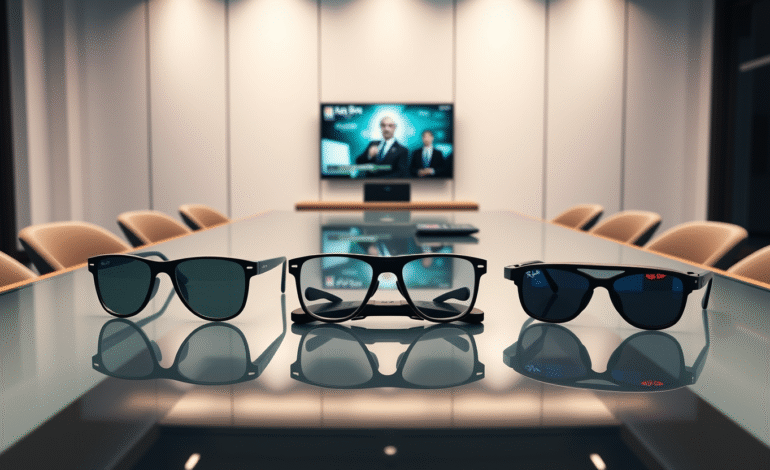
On Wednesday, Meta unveiled three new pairs of smart glasses, including an upgraded version of its existing Ray-Ban models, a new Ray-Ban Display equipped with a wristband controller, and the sports-focused Oakley Vanguard. However, throughout the event, several live technology demonstrations faced technical difficulties.
During one demo, cooking content creator Jack Mancuso asked his Ray-Ban glasses for assistance with a specific sauce recipe. Repeatedly asking, “What do I do first?”, he received no response. The AI then advanced in the recipe, causing him to halt the demonstration. He attributed the issue to potential Wi-Fi problems and passed the conversation back to Meta CEO Mark Zuckerberg.
In another demo, the glasses failed to pick up a live WhatsApp video call between Bosworth and Zuckerberg; Zuckerberg eventually had to abandon the attempt. Bosworth humorously addressed the “brutal” Wi-Fi issues onstage.
Bosworth later took to Instagram for a Q&A session about the new technology and the live demo failures. Regarding the latter, he clarified that it wasn’t actually the Wi-Fi that caused the issue with the chef’s glasses. Instead, it was an oversight in resource management planning.
“When the chef said, ‘Hey, initiate Live AI,’ it started every single Ray-Ban’s Live AI in the building,” Bosworth explained. “There were a lot of people in that building, and that didn’t happen in rehearsals; we didn’t have as many things.”
While this issue alone wasn’t sufficient to cause the disruption, another problem arose due to how Meta routed the Live AI traffic to its development server during the demo. The server was isolated for the demonstration, but when it did so, it affected all headsets in the building.
“Effectively, we DDoS’d ourselves with that demo,” Bosworth added, using a term referring to a distributed denial of service attack where a surge of traffic overwhelms a server or service, slowing it down or making it unavailable. In this case, Meta’s development server was not designed to handle the influx of traffic from other glasses in the building – the company had only prepared for the demos alone.
The failed WhatsApp call, on the other hand, resulted from a new bug. Bosworth revealed that the smart glasses’ display went into sleep mode at the exact moment the call arrived, and when Zuckerberg reactivated the display, it did not show the incoming call notification. This was a “race condition” bug, where the outcome depends on the unpredictable and uncoordinated timing of two or more different processes trying to access the same resource concurrently.
“We’ve never encountered this bug before,” Bosworth noted. “That’s the first time we’ve seen it. It’s fixed now, and that’s a terrible place for that bug to manifest.” He emphasized that Meta is well-versed in handling video calls and was disheartened by the bug’s emergence during this particular event.
Despite the issues, Bosworth remains optimistic about the product’s performance.
“Obviously, I’m not thrilled, but I know the product functions effectively,” he said. “So it was essentially just a demo failure and not a product failure.”