Al Gore’s New AI Tool Exposes Global Polluters, Highlighting Deadly Effects of Fine Particulate Matter
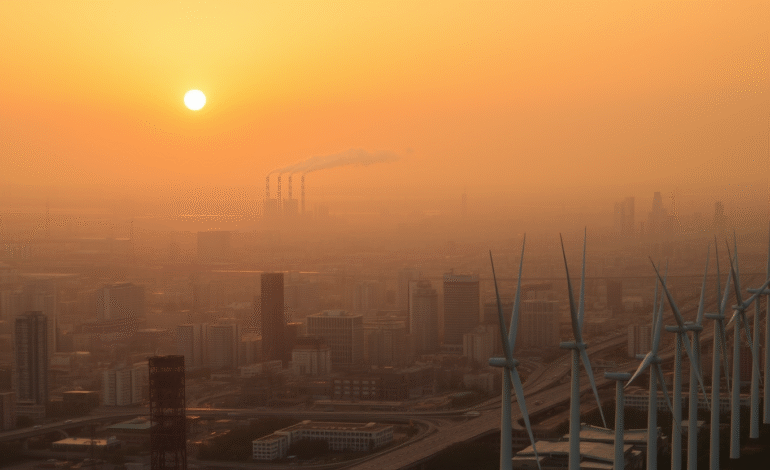
A groundbreaking initiative spearheaded by a former vice president aims to expose and address air pollution on an unprecedented scale. The non-profit organization, Climate Trace, has unveiled a novel tool that leverages artificial intelligence (AI) to track fine particulate pollution from over 660 million sources across the globe.
The burning of fossil fuels is commonly known for its contribution to global warming, but fewer are aware that this process also generates deadly fine particulate matter responsible for an estimated 10 million annual deaths worldwide.
“For some time now, I’ve been advocating for increased attention towards the global public health crisis associated with what some call conventional air pollution or PM2.5,” stated the ex-vice president in a conversation. “It has been challenging for people to access precise information about the pollution they are exposed to, its origin, and the quantities involved.”
Initially established to monitor greenhouse gas emissions globally, Climate Trace began developing this innovative tool after the former vice president collaborated with community members in Memphis, Tennessee, seeking to halt the construction of a crude oil pipeline that threatened their neighborhoods and water sources. During this process, he became acutely aware of the pollutants emanating from nearby refineries affecting the local communities.
“I posed the question to our coalition at Climate Trace: Can we track these pollutants worldwide?” he revealed.
The resulting tool offers users access not only to raw data on major polluters but also visualizations depicting where PM2.5 pollution disperses near large cities. Over time, these plume visualizations will become available globally, the former vice president assured.
Though people have long been aware of soot’s detrimental effects, it was only recently that Climate Trace and its academic partners at Carnegie Mellon University were able to compile global data on the issue into a coherent, verifiable format.
“The very idea of tracking 662 million sites around the world—without AI, people couldn’t have imagined such a feat,” he said. “Yet, as we’ve all witnessed in recent years, AI is capable of extraordinary accomplishments.”
Scientists are only now beginning to understand the far-reaching health implications of fine particulate pollution. Previous research has established its links to lung cancer and heart disease; however, over the past decade, they have also demonstrated that exposure to PM2.5 increases the risk of various other fatal conditions, including low birth weight, kidney disease, Parkinson’s, Alzheimer’s, dementia, type 2 diabetes, and more. Even within legal limits, fine particulate pollution is responsible for tens of thousands of excess deaths in the U.S. annually.
Much of the early research into PM2.5’s health impacts was spearheaded by Joel Schwartz, a scientist whose work decades ago led to the ban on leaded gasoline. The former vice president hopes that increased awareness about fossil fuels’ detrimental health effects will catalyze broader action, mirroring the impact of the ban on leaded gasoline.
“I believe this newfound understanding creates a conducive environment and motivates change that could potentially accelerate the transition away from carbon-intensive facilities,” he stated. “It increases the likelihood of securing political backing for converting these facilities into significantly less emitting technologies.”