Huawei Unveils Groundbreaking SuperPoD Technology: A Single Logical Machine Revolutionizing Global AI Infrastructure

At HUAWEI CONNECT 2025, Huawei unveiled a groundbreaking advancement in AI infrastructure architecture that could revolutionize the way the world constructs and scales artificial intelligence systems. The Chinese tech giant introduced SuperPoD technology, an innovative solution that merges thousands of powerful AI chips scattered across numerous server cabinets into a single, colossal computational unit.
Instead of the conventional method where individual servers operate somewhat independently, Huawei’s new technology creates a unified logical machine from thousands of separate processing units. This allows for more efficient learning, thinking, and reasoning capabilities as opposed to individual servers.
The technical implications stretch beyond impressive specifications, signaling a shift in how AI computing power can be organized, scaled, and deployed across various industries.
At the heart of this infrastructure is UnifiedBus (UB), a cutting-edge interconnect protocol developed by Huawei. The company’s CEO of the ICT Business Group, Yang Chaobin, explained that “Huawei has built the SuperPoD architecture upon our groundbreaking UnifiedBus interconnect protocol, allowing for deep integration among physical servers to facilitate learning, thinking, and reasoning as if they were a single logical server.”
The technical specifications highlight the magnitude of this achievement. The UnifiedBus protocol addresses two challenges that have historically limited large-scale AI computing: reliability in long-range communications and bandwidth-latency. Traditional copper connections provide high bandwidth but only over short distances, typically connecting two cabinets at a time.
Optical cables support longer ranges but suffer from reliability issues that become more problematic the greater the distance and scale. To tackle these fundamental connectivity challenges, Huawei’s Deputy Chairman and Rotating Chairman, Eric Xu, emphasized their importance to the company’s AI infrastructure strategy.
Xu outlined the solutions in terms of the OSI model: “We have built reliability into every layer of our interconnect protocol, from the physical layer and data link layer, all the way up to the network and transmission layers. There is 100-ns-level fault detection and protection switching on optical paths, making any intermittent disconnections or faults of optical modules imperceptible at the application layer.”
The Atlas 950 SuperPoD represents the flagship implementation of this architecture, featuring up to 8,192 Ascend 950DT chips in a configuration delivering “8 EFLOPS in FP8 and 16 EFLOPS in FP4.” Its interconnect bandwidth will be an impressive 16 PB/s. In comparison, a single Atlas 950 SuperPoD will have an interconnect bandwidth over 10 times higher than the entire globe’s total peak internet bandwidth.
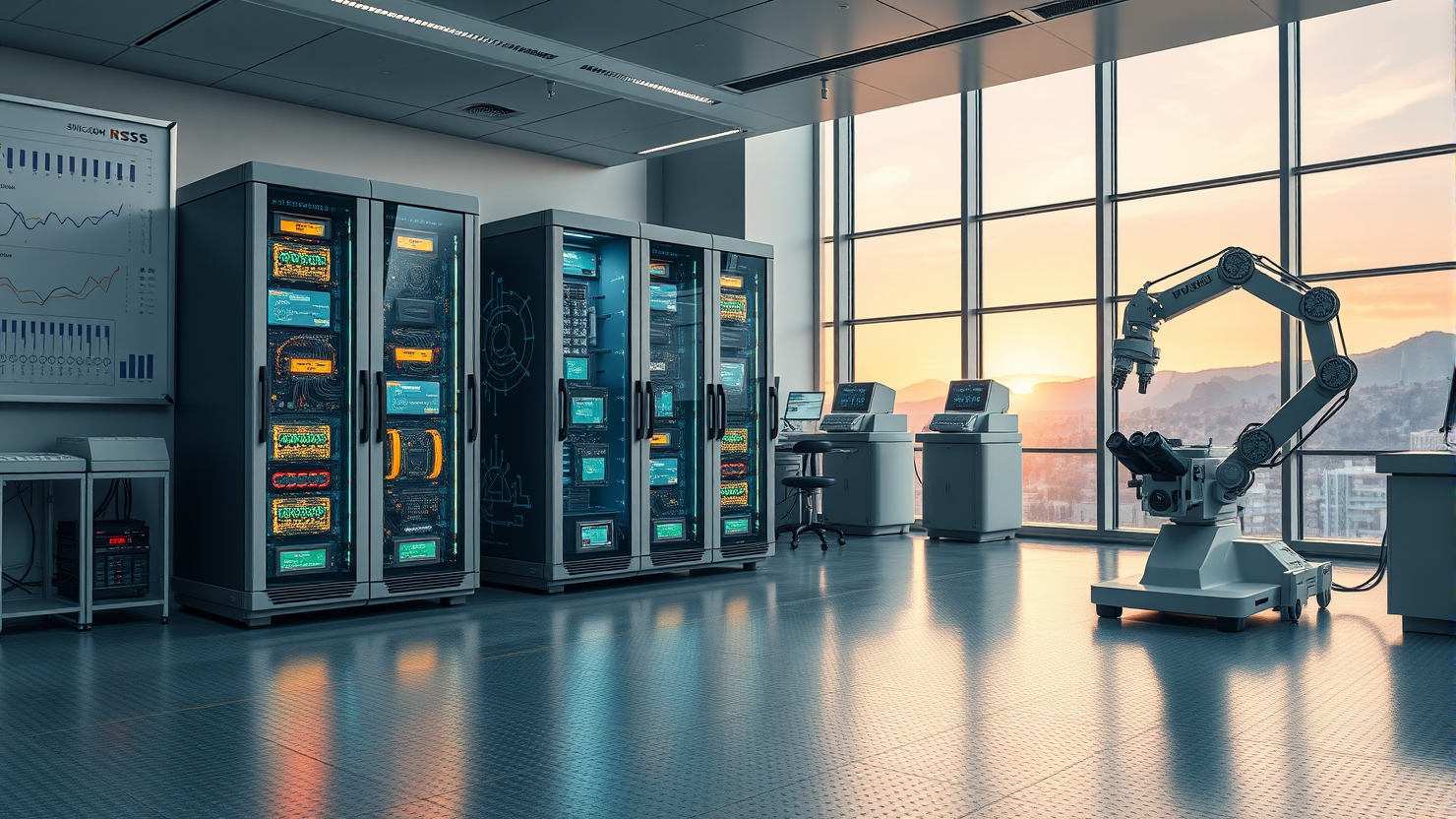
The specifications encompass more than incremental improvements. The Atlas 950 SuperPoD occupies 160 cabinets in 1,000m2, with 128 compute cabinets and 32 comms cabinets linked through all-optical interconnects. The system’s memory capacity reaches 1,152 TB and maintains a remarkable 2.1-microsecond latency throughout the entire system.
Later in the production pipeline will be the Atlas 960 SuperPoD, which is set to incorporate 15,488 Ascend 960 chips in 220 cabinets covering 2,200m2. This model will deliver “30 EFLOPS in FP8 and 60 EFLOPS in FP4,” while offering 4,460 TB of memory and boasting a 34 PB/s interconnect bandwidth.
The SuperPoD concept extends beyond AI workloads into general-purpose computing through the TaiShan 950 SuperPoD. This system leverages Kunpeng 950 processors to address enterprise challenges in replacing legacy mainframes and mid-range computers, particularly within the finance sector.
Xu position this offering as highly relevant for financial institutions, as “the TaiShan 950 SuperPoD, combined with the distributed GaussDB, can serve as an ideal alternative, and replace—once and for all—mainframes, mid-range computers, and Oracle’s Exadata database servers.”
In a significant move for the broader AI infrastructure market, Huawei announced the release of UnifiedBus 2.0 technical specifications as open standards. This strategic decision addresses both domestic technological constraints and the need for widespread collaboration to drive innovation.
Yang emphasized that “we are committed to our open-hardware and open-source-software approach, which will help more partners develop their own industry-scenario-based SuperPoD solutions.” To this end, Huawei plans to open-source hardware and software components, including NPU modules, air-cooled and liquid-cooled blade servers, AI cards, CPU boards, and cascade cards. For software, the company committed to fully open-sourcing CANN compiler tools, Mind series application kits, and openPangu foundation models by 31 December 2025.
Real-world deployment provides validation for these technical claims. Over 300 Atlas 900 A3 SuperPoD units have already been shipped in 2025, with deployments across more than 20 customers from multiple sectors, including the Internet, finance, carrier, electricity, and manufacturing industries.
These advancements have significant implications for China’s AI infrastructure development, as Huawei is working to build a competitive AI infrastructure within parameters set by constrained semiconductor manufacturing and availability. The open ecosystem around domestic technology enables broader industry participation in developing AI infrastructure solutions without requiring access to the most advanced process nodes.
For the global AI infrastructure market, Huawei’s open architecture strategy presents an alternative to the tightly integrated, proprietary hardware and software approach dominant among Western competitors. Whether this proposed ecosystem can achieve comparable performance and maintain commercial viability remains to be demonstrated at scale. Ultimately, the SuperPoD architecture represents a potential game-changer in AI computing, promising to reshape competitive dynamics within the global AI infrastructure market.