Honda and Astrobotic Partner to Develop a Closed-Loop Energy Cycle for Continuous Power on the Moon
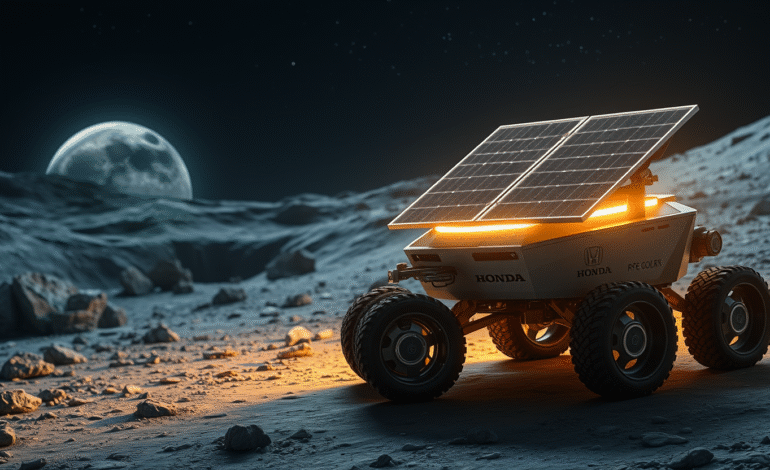
Honda, a global automotive leader, has formed a partnership with lunar exploration startup Astrobotic to investigate the potential of integrating Honda’s regenerative fuel cell (RFC) technology into Astrobotic’s LunaGrid, a scalable power service based on solar arrays.
The collaboration will involve studying the feasibility of implementing Honda’s RFC system within LunaGrid, as well as assessing system scalability and hardware and software integration at potential lunar south pole landing sites. The duo plans to conduct ‘illumination studies’ to evaluate the effectiveness of their combined power solutions during the long lunar nights.
One of the primary challenges in lunar exploration is surviving the two-week-long lunar night, during which temperatures can drop as low as -424 degrees Fahrenheit in certain regions while solar panels remain dormant. Honda’s RFC offers a solution by storing solar energy as hydrogen during the lunar day and converting it into electricity at night, producing water as the only byproduct.
The generated water is then recycled through a high-pressure electrolysis system to create more hydrogen, forming what Honda refers to as “a closed-loop energy cycle.”
Astrobotic’s Vertical Solar Array Technology (VSAT) has been designed to optimize solar energy capture by tracking the sun. With a capacity of up to 10 kilowatts, VSAT collects sunlight during the day to power the water electrolysis system. In conjunction with Honda’s RFC, this stored hydrogen can be converted into electricity throughout the lunar night.
The objective is to establish a dependable and continuous power supply on the lunar surface, enabling more ambitious future missions and potentially sustaining human presence on the Moon.
Established in 2007, Astrobotic, based in Pittsburgh, has gained recognition for its Peregrine lunar lander, which launched earlier this year but did not complete its mission. The company is also working on developing power and mobility systems as part of its goal to establish a lunar economy.
This partnership represents a significant step for Honda into the space sector, marking their first public agreement to apply their fuel cell technology toward lunar exploration. The collaboration aligns with Japan’s broader space aspirations, supporting the country’s role as a founding member of the Artemis Accords – a framework for international collaboration in lunar exploration – and routine Japanese astronaut research on the International Space Station.
The lunar south pole is of significant interest to NASA’s Artemis program due to its near-continuous exposure to sunlight and potential vast stores of water ice. Power systems like LunarGrid, combined with Honda’s RFC technology, could pave the way for more advanced future missions and a sustained human presence on the Moon.